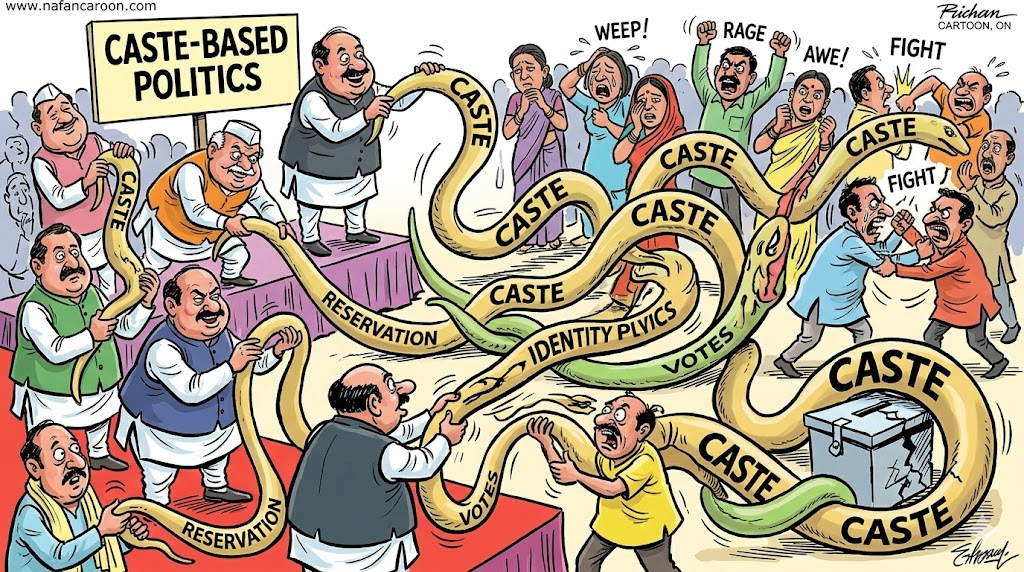
The Tail of Caste: Democracy’s Most Reliable Organ
The disappearance of the tail in human evolution was perhaps one of nature’s historic blunders—at least, that’s what humans seem to believe. Otherwise, why would they keep looking over their shoulders, just in case it has grown back? Deep down, there’s a lingering regret—if only the tail returned, what fun it would be! After all, this is man: gifted with the extraordinary ability to think, reason, and reflect… and yet, instead of valuing that, his eyes remain fixed on finding a tail. Peace eludes him.
Some well-wishers tried to console him:
“Brother, you already have a nose! You can poke it into any matter you like. It’s perfectly capable of meddling and even ruining things.”
But man was not convinced. A nose can only sniff—and it can be cut off at any moment. A tail, however, has a certain flair. After all, Hanuman set Lanka ablaze with his tail. Surely, we could at least torch a few chosen enemies’ homes! With a tail, one could wrap, trip, topple—deliver social somersaults at will.
The nose is limited; the tail is multifunctional.
And thus, man finally found inner peace—when a tail of caste was tied behind him.
A tail so conveniently bestowed at birth—free of cost. Along with the child’s name, weight, and height, the hospital silently attaches an invisible yet fully recognized appendage: the tail of caste.
A stubborn, adhesive tail that stays for life. Sometimes it beats the drum of identity; sometimes it turns into a dagger of hostility. At times it hangs like a bell around the neck, at others it cracks like a whip on others’ backs. Decorative when needed, protective when required.
The uses of this caste-tail are astonishingly versatile. Your importance is calibrated by your tail. Whether people question you or not depends entirely on its color, shape, length, and lineage.
Flies of questions buzzing around your nose? One flick of the tail—gone.
The hum of responsibility? Cleared in a snap.
It also comes with a license—to be a victim, to appear as one, and when the opportunity arises, to distribute victimhood as well. A full moral toolkit of oppression, injustice, and discrimination—ready for deployment.
If someone argues too much, just wrap them in your tail and give them a few social flips. These days, that’s called “direct dialogue.”
This tail is not just identity—it’s a complete toolkit: position, prestige, greetings, jobs, wealth, contracts, power, marriage, politics, neighborhood, institutions—everywhere the tail arrives first, the human follows later. If you have a tail, you have access.
Humans have learned to wear and spread this tail like a blanket.
Yes, some tails stink—and flies buzz persistently. Perhaps the stench is necessary to keep the flies seated. Some are so inactive they can’t even shake their tails to drive them away. In fact, those very flies become their badge of victimhood in society.
Politics was the first to recognize the true potential of this tail. Once, politics was driven by policy; now, caste precedes policy. Manifestos have shrunk; caste lists have expanded. Leaders flaunt their tails in speeches, aligning them with yours. Once elected, they tuck them neatly into their pockets—only to pull them out when needed again. Ruling party or opposition—tails are equally long, only the colors differ.
Voters are no less clever. Roads, water, schools, hospitals—later. First, they check: who is stroking my tail? The one who strokes it best is the most deserving. If one’s honor is secure, one can even fall proudly into a pothole.
Caste pride is a deeply emotional breed of pride—logic is strictly prohibited. Say, “We should rise above caste and be human,” and the other person is instantly offended:
“So you want to erase our identity?”
Identity is a fragile thing. A slight breeze can shatter it. Yet, when it comes to breaking someone else’s identity, the same becomes steel.
Social media has now given this tail digital wings. Profile pictures, bios, hashtags—caste pride flutters everywhere. Posts make it seem as if civilization itself would collapse without caste. Even history is now dyed in the color of the tail: those who belong to us are महान; the rest are suspect.
And the irony? The man proud of his tail has forgotten how to walk. He hangs from the branch of democracy, clinging by his tail. Moving forward is unnecessary—jumping and swinging is enough. He knows that if he starts walking, the tail might lose its importance.
And that, perhaps, is the most enduring achievement of our democracy—
everyone stands proudly, sporting their caste-tails, twirling their mustaches.
Democracy is functioning… or rather, hanging—by its tails.
— Dr. Mukesh ‘Aseemit’

Comments ( 0)
Join the conversation and share your thoughts
No comments yet
Be the first to share your thoughts!